
Lumminova InnateSignal™
〰️
Lumminova InnateSignal™ 〰️
ENGAGING THE BODY’S INNATE SYSTEMS OF REST, REGULATION & RECOVERY
INTRODUCTION to aVNS
For a broader introduction to auricular vagus nerve stimulation (aVNS), please explore our aVNS Clinical Evidence Guide. It provides important background on how aVNS works, together with a detailed review of the clinical research and its potential applications across a wide range of health conditions.
Skin Health
Psoriasis
Psoriasis is much more than a surface skin condition. It is an immune-mediated inflammatory disease, and the redness, thickening and scaling seen on the skin reflect inflammatory activity occurring within it.
Vagus nerve stimulation has now produced some particularly striking findings in experimental psoriasis.
A biological response after only five minutes
In an animal model of psoriasis, researchers delivered just one five-minute session of implanted vagus nerve stimulation.
Within six hours, inflammatory activity within the affected skin had fallen dramatically:
TNF-α ↓ approximately 63%
IL-6 ↓ approximately 63%
Even more remarkably, the effect was still clearly present 24 hours later:
TNF-α ↓ approximately 69%
IL-6 ↓ approximately 60%
That means inflammatory activity remained substantially reduced a full day after only five minutes of stimulation.
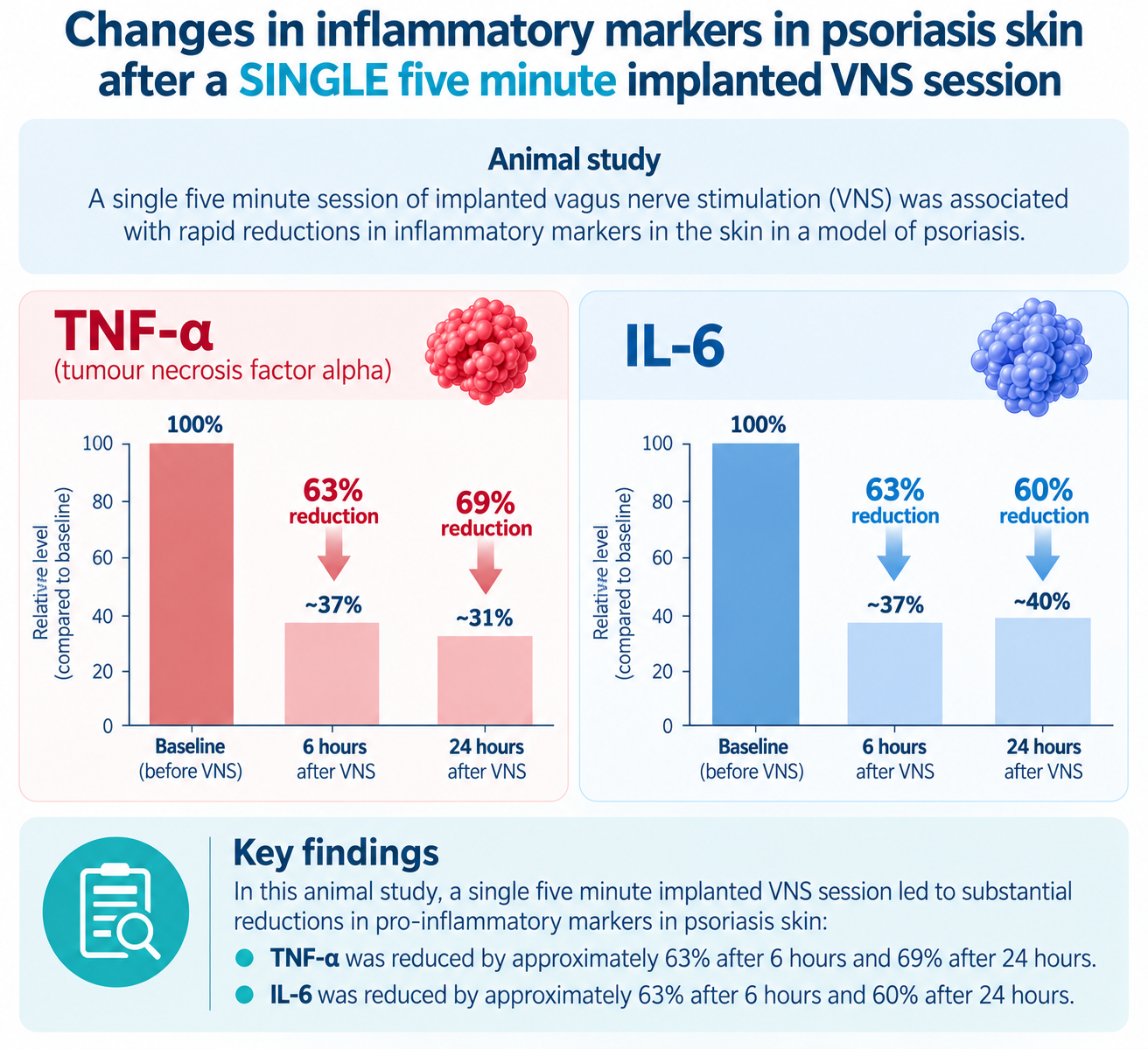
The treatment used direct implanted VNS rather than stimulation through the ear, but the findings demonstrate something important: vagus nerve stimulation can produce a powerful and sustained change in inflammatory signalling within psoriatic skin itself.
What has happened in people with psoriasis?
Based on the remarkable findings from implanted VNS animal studies, researchers have also begun studying non-invasive aVNS in people with plaque psoriasis using 30 minutes of home treatment each day for three months.
Preliminary results reported from seven participants were encouraging: average psoriasis severity scores fell by approximately two-thirds over the three-month treatment period.
In one participant, cumulative daytime salivary cortisol also fell by approximately 40% during treatment.
This finding may be relevant because stress and psoriasis frequently interact. Cortisol is an important part of the body’s normal stress response, but prolonged disturbance of stress regulation can affect immune function and contribute to inflammatory disease.
The combination of substantial changes in inflammatory signalling in laboratory research and early improvement in psoriasis severity in people using aVNS provides a promising foundation for further clinical use and study.
For someone whose psoriasis is persistent or difficult to control, aVNS offers the possibility of a simple home-based approach aimed at supporting both inflammatory and stress-related regulation.
Atopic Eczema
Atopic eczema is driven by a combination of skin-barrier dysfunction and poorly regulated immune activity. This produces the familiar cycle of dryness, inflammation, itching, scratching and recurrent flares.
Recent vagus nerve stimulation research has produced some remarkable objective findings.
A single five-minute treatment
In a 2026 animal study of eczema-like skin inflammation, researchers delivered only one five-minute session of implanted VNS.
Twenty-four hours later:
TNF-α ↓ approximately 68%
IL-6 ↓ approximately 66%
IL-1β ↓ approximately 48%
Once again, a substantial anti-inflammatory response remained clearly detectable a full day after only five minutes of stimulation.
And importantly, non-nvasive aVNS has also worked
A separate 2026 study is particularly relevant to InnateSignal because researchers used non-invasive auricular stimulation through the ear.
Animals with eczema-like inflammation received brief five-minute treatments every two to three days for one or two weeks.
The changes within the skin included:
less abnormal skin thickening
less swelling
fewer inflammatory mast cells
reductions in IL-4, IL-1β and TNF-α
and reduced activity of NF-κB, an important inflammatory pathway.
These were not simply changes in the appearance of the skin. Researchers demonstrated measurable changes within the inflamed tissue itself.
For people living with recurrent eczema, this raises an appealing possibility: supporting the body’s own inflammatory regulation through brief, non-invasive stimulation may eventually help calm inflammation and reduce the tendency towards repeated flares.
Human studies will tell us how much of these impressive laboratory findings can be reproduced in people. Fortunately a large number of animal study findings have later been replicated in human clinical studies so the preliminary animal data gives reason for hope.
Vitiligo
Vitiligo is an immune-mediated condition in which melanocytes—the cells responsible for producing skin pigment—are damaged or lost.
Recent preclinical aVNS research has produced findings that go considerably beyond simply reducing inflammation.
In a mouse model of vitiligo, animals receiving aVNS developed less visible depigmentation and white hair than untreated animals.
After four weeks, researchers also found significantly more melanin around the hair follicles and movement of melanin granules towards the surface of the skin.
Importantly, this was not simply a visual impression. Laboratory analysis demonstrated several biological changes that could potentially support pigment-cell survival and repigmentation:
increased tyrosinase, an enzyme essential for melanin production;
increased superoxide dismutase and catalase, important antioxidant defences;
reduced malondialdehyde, indicating less oxidative damage;
suppression of inflammatory signalling;
better preservation of melanocyte-associated pigment; and
increased melanin around hair follicles on microscopic examination.
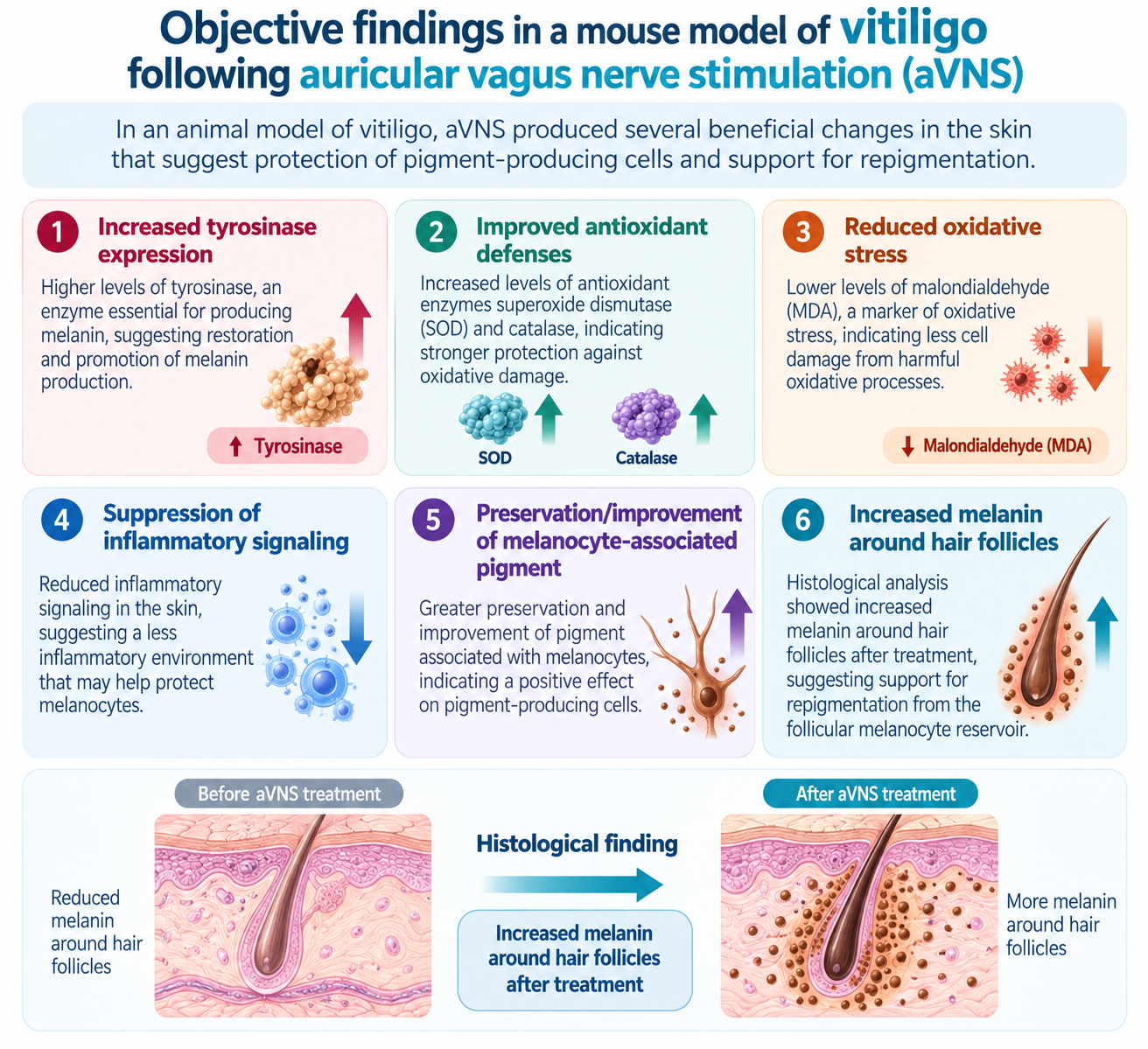
The increase pigment around the hair follicles is notable: the hair follicle contains an important reservoir of melanocytes and melanocyte precursor cells that can contribute to repigmentation.
For someone with vitiligo, the significance is therefore broader than simply “reducing inflammation.” The experimental findings suggest that aVNS may create a more favourable environment for protecting pigment-producing cells, reducing oxidative stress and supporting the biological processes involved in repigmentation.
The evidence is currently preclinical, but the combination of visible improvement and objective changes in melanin, antioxidant defences, inflammatory activity and pigment-cell biology makes these findings particularly encouraging.
Explore Luminnova InnateSignal™
Learn more about the Luminnova InnateSignal™ aVNS Program, including how the program works, what to expect, treatment options and how to determine whether InnateSignal™ may be appropriate for you.
Click here to explore the InnateSignal™ aVNS Program.
REFERENCES
Skin Health
Rosacea
Li J, Wei J, Zhang M, et al. Transcutaneous Auricular Vagus Nerve Stimulation Treatment for Erythematotelangiectatic Rosacea: A Randomized Clinical Trial. JAMA Dermatology. 2025;161(12):1229–1237. doi:10.1001/jamadermatol.2025.3796. PMID: 41060641.
Randomized human clinical trial.
Psoriasis
Transcutaneous auricular vagus nerve stimulation inhibits mental stress-induced cortisol release—Potential implications for inflammatory conditions. PMID: 39936474.
Human physiological study with additional preliminary psoriasis observations.
Atopic Dermatitis — Preclinical
Lee CM, Shin JH, Song JJ. Efficacy of atopic dermatitis alleviation through transcutaneous auricular vagus nerve stimulation in 2,4-dinitrochlorobenzene (DNCB)-induced mouse model. Annals of Medicine. 2026;58(1):2680845. doi:10.1080/07853890.2026.2680845. PMID: 42263156.
Preclinical aVNS study — improvements in skin pathology and inflammatory markers.
Psoriasis & Atopic Dermatitis — Preclinical
Nahm WJ, Kim KJ, et al. Vagus Nerve Stimulation Reduces Cutaneous Inflammation and Proinflammatory Cytokines in Murine Models of Psoriasis and Atopic Dermatitis. Experimental Dermatology. 2026;35(6):e70297. doi:10.1111/exd.70297. PMID: 42281200.
Preclinical implanted-VNS study — substantial reductions in cutaneous TNF-α, IL-1β and IL-6.
Vitiligo — Preclinical
Luo S, Meng X, Ai J, et al. Transcutaneous Auricular Vagus Nerve Stimulation Alleviates Monobenzone-Induced Vitiligo in Mice. International Journal of Molecular Sciences. 2024;25(6):3411. doi:10.3390/ijms25063411. PMID: 38542385.
Preclinical aVNS mouse model.