
Lumminova InnateSignal™
〰️
Lumminova InnateSignal™ 〰️
ENGAGING THE BODY’S INNATE SYSTEMS OF REST, REGULATION & RECOVERY
INTRODUCTION to aVNS
For a broader introduction to auricular vagus nerve stimulation (aVNS), please explore our aVNS Clinical Evidence Guide. It provides important background on how aVNS works, together with a detailed review of the clinical research and its potential applications across a wide range of health conditions.
Migraine Headaches
Migraine is one of the most extensively investigated areas of vagus nerve stimulation for pain, and the findings provide meaningful reasons for people living with recurrent migraine to consider aVNS.
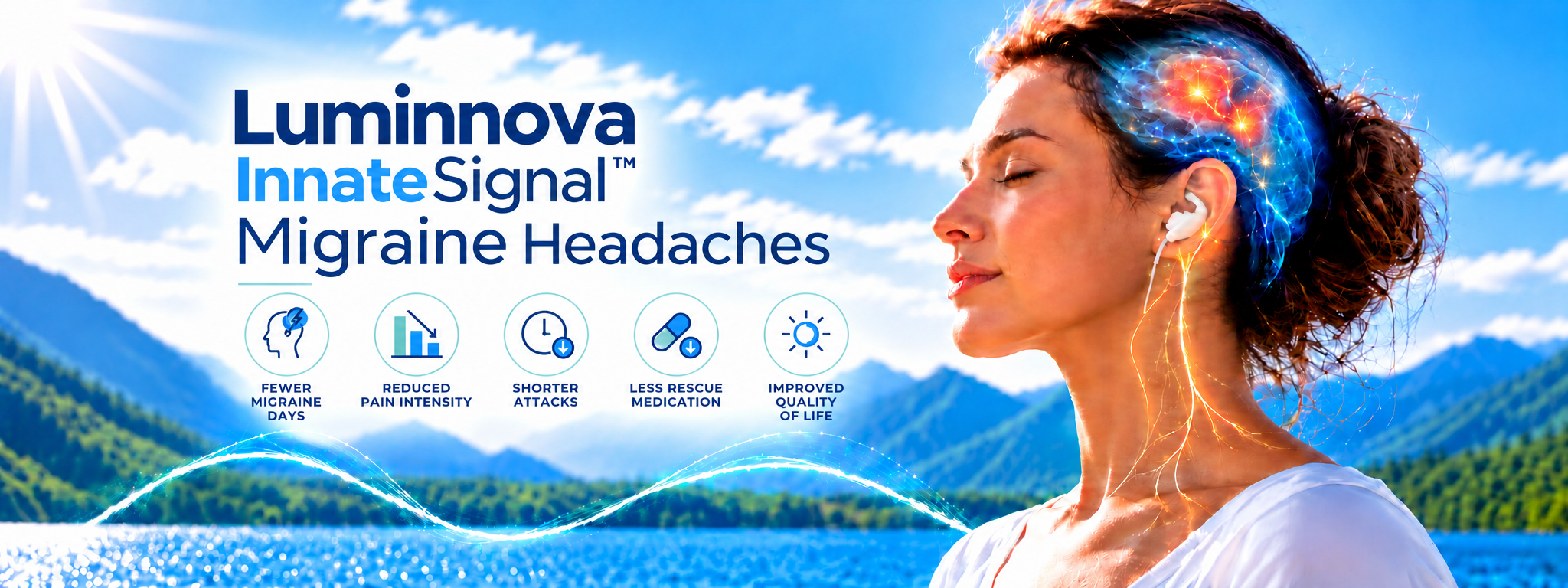
For someone with migraine, improvement means much more than simply lowering a pain score. Fewer migraine days, shorter or less disabling attacks, less reliance on rescue medication and being able to make plans without constantly anticipating the next attack can make a substantial difference to everyday life.
Clinical studies of vagus nerve stimulation have reported improvements in several of these areas, including:
fewer migraine and headache days
reduced headache intensity
improvement in migraine-related disability
reduced use of acute or rescue medication
improvement during individual migraine attacks
and, in some studies, improvement in associated symptoms such as nausea and sensitivity to light and sound.
Importantly, the evidence is no longer based on isolated small studies. Reviews combining the results of randomized clinical trials have found that non-invasive vagus nerve stimulation can reduce headache burden, and analyses specifically examining auricular vagus nerve stimulation have found reductions in migraine days and headache intensity.
What does the evidence show regarding migraine frequency?
There is encouraging evidence that regular vagus nerve stimulation may reduce the tendency for migraines to occur.
In one randomized study involving people with chronic migraine, participants using low-frequency auricular vagus nerve stimulation experienced an average reduction of approximately 7 headache days per month after 12 weeks, compared with approximately 3 days with the alternative stimulation frequency. Furthermore**, almost a third of participants experienced at least a 50% reduction in headache days**. Measures of migraine-related disability also improved.
This is particularly relevant for people whose lives are repeatedly interrupted by migraine. Even a partial reduction in frequency can potentially mean several additional migraine-free days each month.
More recent analyses combining multiple clinical trials have reinforced the overall picture, reporting reductions in monthly headache days, headache intensity and use of acute migraine medication with non-invasive vagus nerve stimulation.
What about using vagus nerve stimulation during a migraine?
Vagus nerve stimulation has also been studied as a treatment used during an individual migraine attack.
Some people experience improvement relatively quickly, including reductions in pain and associated migraine symptoms. Larger randomized studies of non-invasive vagus nerve stimulation have demonstrated increased rates of early pain relief or freedom from pain compared with comparison stimulation.
The response does not necessarily persist after a single stimulation session in everyone. In some studies, symptoms returned after initial improvement, suggesting that repeat stimulation during an attack may sometimes be useful.
This possibility of using vagal stimulation in two different ways — regularly to help reduce migraine frequency and during an attack to potentially reduce its immediate burden — is one of the reasons migraine is such an important application of vagus nerve stimulation.
What about children and teenagers?
Migraine can begin surprisingly early in life, so parents may understandably wonder whether vagus nerve stimulation has been studied in younger people.
It has.
Non-invasive vagus nerve stimulation has been evaluated for acute migraine treatment in adolescents, with encouraging results and no device-related adverse events reported in one preliminary study. Almost half of the treated attacks were successfully managed without the need for rescue medication.
There is also now published experience specifically with auricular vagus nerve stimulation in a child with difficult-to-treat chronic migraine. An 8-year-old boy with migraine with aura had experienced two to three attacks each week, often lasting around 24 hours. During a structured taVNS programme, headache duration and frequency fell substantially, the aura resolved, medication use decreased and improvement was maintained during follow-up. No adverse events were reported.
This is only an individual case and cannot establish effectiveness in children by itself, but it is reassuring that auricular stimulation has been used successfully and was well tolerated in a young child. A randomized clinical trial specifically studying taVNS for prevention and treatment of primary headache in children and adolescents is also underway.
Why might vagus nerve stimulation influence migraine?
Migraine is not simply a headache. It involves altered activity across brainstem and higher brain networks involved in pain processing, sensory sensitivity, autonomic regulation and the development and maintenance of a migraine attack.
Vagal stimulation provides a way of influencing these networks without medication.
Rather than simply attempting to numb pain, stimulation of vagal pathways appears capable of modifying neural systems involved in how migraine begins, how pain is processed and how the nervous system responds during an attack.
For someone whose migraines remain disruptive despite existing strategies — or who would like to add a non-drug neuromodulation option — the possibility of reducing both the frequency and burden of attacks provides a meaningful reason to explore aVNS.
Luminnova InnateSignal™ includes migraine programmes based on auricular stimulation approaches that have produced encouraging findings in published clinical research.
Explore Lumminova InnateSignal™
Learn more about the Luminnova InnateSignal™ aVNS Program, including how the program works, what to expect, treatment options and how to determine whether InnateSignal™ may be appropriate for you.
Click here to explore the InnateSignal™ aVNS Program.
REFERENCES
Migraine Headaches
Straube A, Ellrich J, Eren O, Blum B, Ruscheweyh R. Treatment of chronic migraine with transcutaneous stimulation of the auricular branch of the vagal nerve: a randomized, monocentric clinical trial. Journal of Headache and Pain. 2015;16:63. doi:10.1186/s10194-015-0543-3. PMID: 26156114.
Randomized human trial.