
Lumminova InnateSignal™
〰️
Lumminova InnateSignal™ 〰️
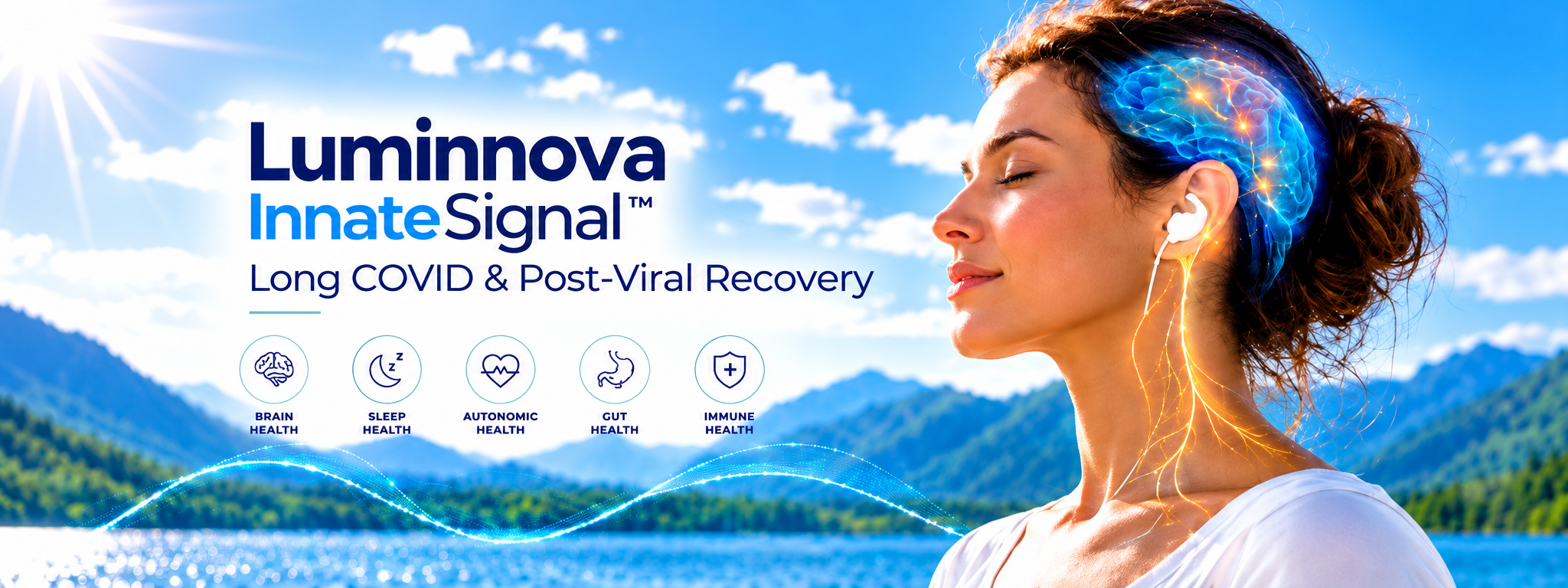
ENGAGING THE BODY’S INNATE SYSTEMS OF REST, REGULATION & RECOVERY
INTRODUCTION to aVNS
For a broader introduction to auricular vagus nerve stimulation (aVNS), please explore our aVNS Clinical Evidence Guide. It provides important background on how aVNS works, together with a detailed review of the clinical research and its potential applications across a wide range of health conditions.
Long COVID and Post-Viral Recovery
For many people, recovery from an infection does not end when the acute illness has passed.
Following COVID-19 and other viral illnesses, some people continue to experience fatigue, brain fog, poor sleep, dizziness, rapid heart rate, exercise intolerance and a persistent feeling that the body has simply not returned to normal.
For some, these symptoms can profoundly affect work, family life, exercise and normal daily activity.
Increasing evidence suggests that persistent inflammatory activity and disruption of autonomic regulation may both contribute to prolonged recovery.
This makes aVNS particularly promising because it has the potential to influence both sides of this problem.
Rather than directly attacking a virus, the goal is to help the body regain healthier immune and autonomic regulation after infection.
What have people with Long COVID experienced?
The early clinical findings are encouraging.
In one study, people with Long COVID received vagus nerve stimulation once weekly for eight weeks. Their average autonomic symptom score fell dramatically—from approximately 34 to 14.
The improvements were not confined to questionnaires. Objective cognitive testing demonstrated a significant improvement in attention and executive function, while measures of psychological stress also improved. No adverse events were reported.
An early randomized pilot study also reported an encouraging signal. During the initial two-week blinded phase, the proportion of nine monitored Long-COVID symptoms—including fatigue, brain fog, headache, dizziness and disturbances of smell or taste—fell from approximately 46% to 31% in the active-treatment group, while there was no corresponding improvement in the comparison group.
For someone struggling with prolonged post-viral symptoms, these findings offer genuine reason for optimism. They suggest that supporting vagal regulation may help the body move away from a prolonged state of autonomic and inflammatory disruption and towards more normal recovery.
For this reason, Luminnova InnateSignal™ includes dedicated Long COVID and post-viral recovery programs.
Explore Lumminova InnateSignal™
Learn more about the Luminnova InnateSignal™ aVNS Program, including how the program works, what to expect, treatment options and how to determine whether InnateSignal™ may be appropriate for you.
Click here to explore the InnateSignal™ aVNS Program.
REFERENCES
Long COVID & Post-Viral Recovery
Badran BW, Huffman SM, Dancy M, et al. A pilot randomized controlled trial of supervised, at-home, self-administered transcutaneous auricular vagus nerve stimulation to manage long COVID symptoms. Bioelectronic Medicine. 2022;8:13. doi:10.1186/s42234-022-00094-y. PMID: 36002874.
Transcutaneous auricular vagus nerve stimulation improves dysautonomia, post-traumatic stress disorder and cognitive impairment in long COVID patients: a pilot study. 2026. PMID: 42106490.
Prospective human pilot — autonomic symptoms and objective cognitive outcomes.
Gierthmuehlen M, Schmieder K, Thon N, Gierthmuehlen PC. Transcutaneous Auricular Vagal Nerve Stimulation Against Fatigue Syndrome in Patients with Long COVID: Results of the Randomized, Placebo-Controlled Clinical Pilot Trial COVIVA. Neurology and Therapy. 2026;15(3):1327–1343. doi:10.1007/s40120-026-00928-w. PMID: 41926033.
Randomized evidence with mixed/negative primary findings — included for balance.