
Lumminova InnateSignal™
〰️
Lumminova InnateSignal™ 〰️

ENGAGING THE BODY’S INNATE SYSTEMS OF RECOVERY
Introduction to aVNS
For a broader introduction to auricular vagus nerve stimulation (aVNS), please explore our aVNS Clinical Evidence Guide. It provides important background on how aVNS works, together with a detailed review of the clinical research and its potential applications across a wide range of health conditions.
Cognitive Health
Changes in memory and thinking can be deeply concerning, particularly when someone has been diagnosed with mild cognitive impairment (MCI) or is worried about progression toward dementia.
There is currently no evidence that aVNS can guarantee prevention of cognitive decline or dementia. However, the findings so far are sufficiently encouraging to provide genuine reason for hope that supporting vagal activity may have a useful role in improving cognitive health.
Importantly, the positive findings are not based on a single observation. Researchers have reported improvements on cognitive testing, objective changes in brain activity associated with cognitive function and evidence of enhanced neuroplasticity. Early Alzheimer’s research has also raised the possibility that vagus nerve stimulation may influence some of the biological processes involved in cognitive decline.
Mild Cognitive Impairment (MCI)
MCI is an especially important area because it represents a stage at which memory and thinking have begun to decline, but significant cognitive function remains—and there is still an opportunity to support the brain before more substantial deterioration occurs.
The early clinical findings with aVNS are encouraging.
In a 24-week double-blind randomized trial, people with MCI receiving active aVNS experienced significantly greater improvement in overall cognitive performance than those who did not receive active treatment. Improvements within the treated group were also seen in verbal memory, executive function, naming, sleep and everyday functioning.
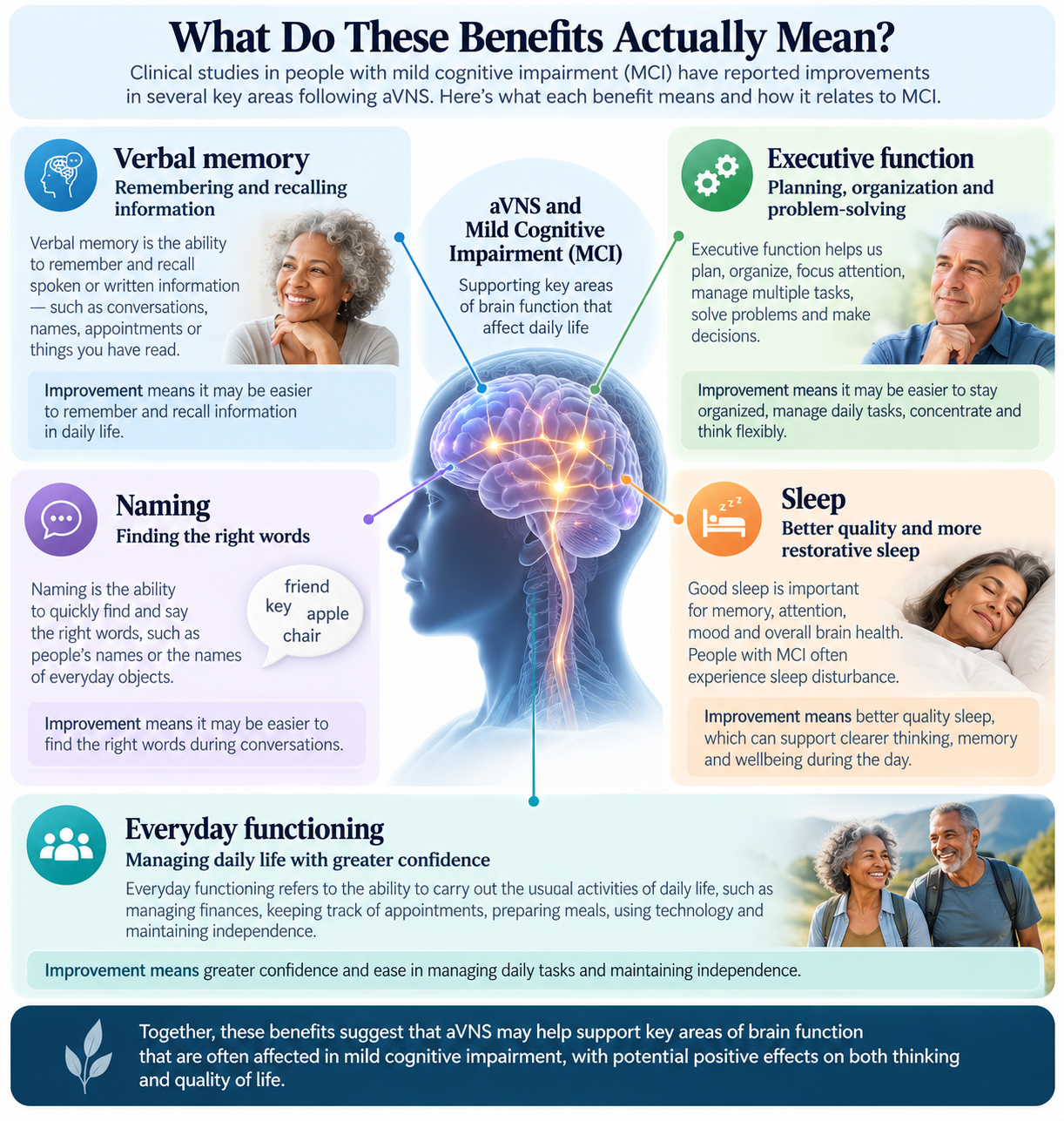
Other MCI research has demonstrated changes in brain networks involved in memory and attention. This is important because it provides objective evidence that aVNS is doing more than simply making people feel more alert—it appears capable of changing activity within brain systems involved in cognition.
There is another potentially important effect: neuroplasticity.
Neuroplasticity is the brain’s ability to adapt and strengthen useful neural connections. Vagus nerve stimulation has been shown to enhance this process, particularly when stimulation is paired with learning, cognitive exercises or rehabilitation. For someone with MCI, supporting the brain’s ability to maintain and strengthen its remaining networks could potentially be valuable.
Could aVNS Help Slow Further Cognitive Decline?
We do not yet know. Studies have not followed enough people for long enough to show that aVNS prevents MCI from progressing to dementia. But there are reasons to be hopeful. If research had shown only a small improvement on a memory test, the implications would be fairly limited. Instead, the emerging picture includes improved cognitive performance, changes in relevant brain networks and enhanced neuroplasticity. Research in Alzheimer’s disease adds another intriguing piece to that picture.
Alzheimer’s Disease
Early laboratory studies have produced some particularly striking findings.
In mice with Alzheimer-like disease, aVNS not only improved learning and memory, but was also associated with changes inside the brain itself. Researchers found less amyloid-beta accumulation and reduced inflammatory activity within the hippocampus, an area essential for memory.
A subsequent study in older mice with more established disease again found improvements in learning and memory together with reductions in Alzheimer-related brain changes.
Interestingly, the stimulation pattern mattered. One particular pattern produced substantial benefits while other patterns did not. This suggests that carefully selecting how the vagus nerve is stimulated may be important.
There is also early human evidence from implanted VNS. People with Alzheimer’s disease were followed for up to a year, and a substantial proportion remained stable or improved on standard cognitive assessments during a period when progressive decline would ordinarily be expected.
These small studies do not prove that VNS can stop Alzheimer’s disease. However, taken together with the aVNS laboratory findings, they raise the important possibility that vagus nerve stimulation might eventually prove capable of influencing the processes contributing to cognitive decline, rather than simply producing a short-lived improvement in concentration or memory.
For someone with MCI, that distinction is important—and it is one of the reasons the research offers genuine hope.
Cognitive Support in People Without MCI
There may also be a role for aVNS before significant cognitive impairment develops.
Stress, poor sleep, fatigue, illness and sustained mental demands can all affect attention, working memory, learning and mental flexibility.
Studies in healthy adults have found improvements in selected aspects of cognitive performance following aVNS. In one randomized study, a particular stimulation pattern improved both working-memory accuracy and response speed.
These improvements were accompanied by measurable changes in brain electrical activity related to attention, cognitive control and working-memory processing, providing objective evidence that stimulation was affecting the brain during the task.
Once again, not every stimulation pattern produced the same results—reinforcing the importance of using treatment parameters that are appropriate for the intended purpose.
What Does This Mean for Someone Concerned About Their Memory?
At this stage, it would be inappropriate to describe aVNS as a treatment proven to prevent dementia. But it would also understate the research to say that there is no meaningful evidence of potential benefit.
There are now positive signals at several levels:
people with MCI have shown measurable cognitive improvement;
brain networks involved in memory and attention have changed following treatment;
VNS can promote neuroplasticity;
early Alzheimer’s research has shown effects on memory as well as underlying brain changes; and
human implanted-VNS studies have provided preliminary evidence of cognitive stabilization or improvement in Alzheimer’s disease.
Taken together, these findings provide a reasonable basis for hope and for considering aVNS as part of a broader cognitive-support strategy—particularly for someone with MCI who wants to take proactive steps while cognitive function is still relatively well preserved.
The Luminnova InnateSignal™ treatment library therefore includes cognitive-support programs based on stimulation patterns used in the available research. These are intended to complement other measures associated with maintaining brain health, including exercise, good sleep, appropriate nutrition, management of cardiovascular and metabolic risk factors, social engagement and continued cognitive activity.
While we cannot guarantee that aVNS will prevent dementia, Luminnova InnateSignal™ aims to make use of a promising, non-invasive approach at a stage when supporting and preserving brain function may matter most.
Explore InnateSignal™
Learn more about the Luminnova InnateSignal™ aVNS Program, including how the program works, what to expect, treatment options and how to determine whether InnateSignal™ may be appropriate for you.
Click here to explore the InnateSignal™ aVNS Program.