
Lumminova InnateSignal™
〰️
Lumminova InnateSignal™ 〰️
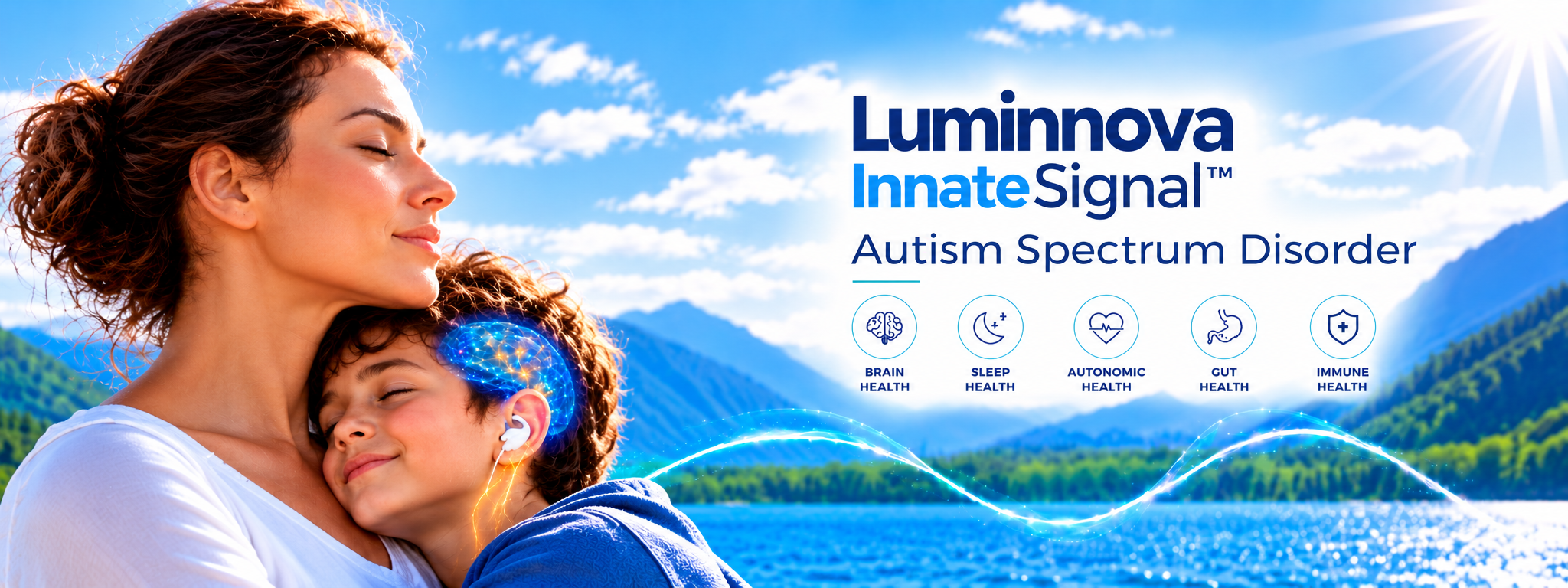
ENGAGING THE BODY’S INNATE SYSTEMS OF RECOVERY
Introduction to aVNS
For a broader introduction to auricular vagus nerve stimulation (aVNS), please explore our aVNS Clinical Evidence Guide. It provides important background on how aVNS works, together with a detailed review of the clinical research and its potential applications across a wide range of health conditions.
Autism Spectrum Disorder
Autism is associated with differences in the way the brain processes social, emotional and sensory information. For some autistic children and adults, additional challenges such as anxiety, difficulty regulating emotions, sleep disturbance and heightened responses to stress can have an important impact on everyday life.
These are areas in which the vagus nerve may be particularly relevant.
The vagus nerve communicates extensively with brain regions involved in social engagement, emotional regulation, attention, stress responses and sensory processing. It also influences autonomic balance and inflammatory signaling — two systems that are increasingly being studied in autism.
EARLY HUMAN FINDINGS ARE ENCOURAGING
aVNS has now been used at home in children with autism.
In an initial study involving children aged 7–16 years, caregivers administered one-hour aVNS sessions each day for two weeks under remote supervision. Treatment was generally well tolerated, with almost 90% of planned sessions successfully completed.
Importantly, the researchers also observed improvements in measures of anxiety and sleep over the two-week treatment period. Because this was a small preliminary study without a comparison group, it cannot establish how much of the improvement was specifically caused by aVNS — but it provided an encouraging first indication that repeated treatment is practical in autistic children and may have clinically meaningful effects.
Researchers have subsequently moved to more rigorous clinical testing. A randomized, double-blind study has been designed specifically to investigate whether aVNS can improve social functioning in autistic children, while brain imaging is being used to determine whether improvement is accompanied by measurable changes in the organization and activity of brain networks.
WHY MIGHT VAGUS NERVE STIMULATION HELP?
One particularly interesting possibility is that aVNS may influence several interconnected systems rather than targeting a single symptom.
Vagal stimulation can affect:
autonomic regulation — potentially improving the body’s ability to shift out of a prolonged stress or heightened-arousal state;
brain networks involved in social and emotional processing;
anxiety and stress regulation;
sleep and recovery; and
neuroimmune and inflammatory signaling.
This last pathway has produced particularly interesting experimental findings.
In a preclinical model of autism, aVNS improved social behavior and reduced anxiety-like behavior. Researchers also found reductions in neuroinflammatory activity, including changes in microglial activation and a reduction in IL-17A, an inflammatory signaling molecule that has attracted considerable interest in autism research. When researchers independently blocked IL-17A, social behavior also improved, providing additional evidence that this inflammatory pathway may have contributed to the response to aVNS.
The importance of these findings is not that results in an animal model can automatically be expected in people. Rather, they provide a biologically measurable explanation for how vagus nerve stimulation could potentially influence some of the neurological and behavioral features being investigated in autism, and they strengthen the rationale for the human studies now underway.
WHAT COULD THIS MEAN FOR SOMEONE WITH AUTISM?
For someone with autism, the practical question is whether improving regulation within the nervous system could translate into meaningful improvements in some of the difficulties that affect everyday life.
Potential areas of interest may therefore include:
social engagement and interaction • anxiety • emotional regulation • sleep • stress tolerance • attention and cognitive flexibility • sensory regulation
The evidence is still at an early stage, particularly compared with some of the more established areas covered in this Guide. However, we already have human experience demonstrating feasibility and encouraging changes in anxiety and sleep, autism-specific randomized clinical research underway, and laboratory evidence showing measurable effects on social behavior and neuroinflammatory pathways.
Together, these findings make autism an important and promising area for continued exploration of aVNS.
Explore InnateSignal™
Learn more about the Luminnova InnateSignal™ aVNS Program, including how the program works, what to expect, treatment options and how to determine whether InnateSignal™ may be appropriate for you.
Click here to explore the InnateSignal™ aVNS Program.