
Lumminova InnateSignal™
〰️
Lumminova InnateSignal™ 〰️
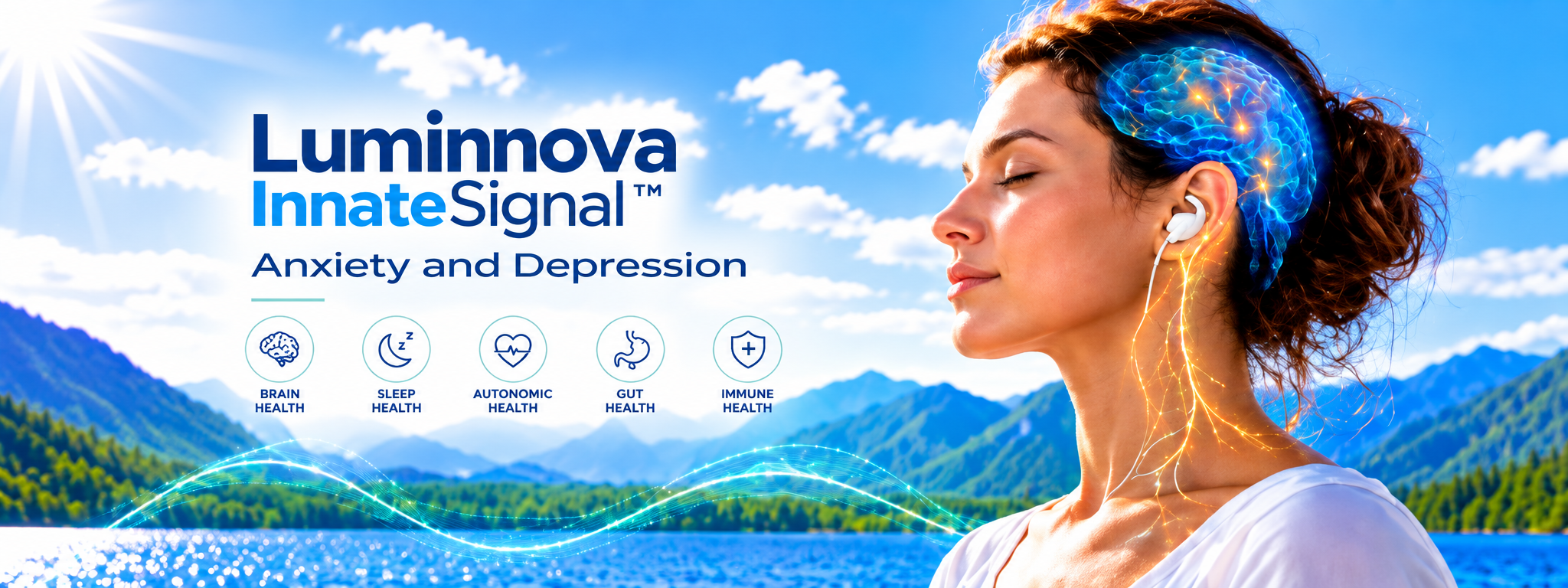
ENGAGING THE BODY’S INNATE SYSTEMS OF RECOVERY
Introduction to aVNS
For a broader introduction to auricular vagus nerve stimulation (aVNS), please explore our aVNS Clinical Evidence Guide. It provides important background on how aVNS works, together with a detailed review of the clinical research and its potential applications across a wide range of health conditions.
Anxiety & Depression
Anxiety, persistent stress and depression can feel very different, but they share important connections with the nervous systems that regulate arousal, emotional processing, sleep and the body’s response to stress.
The vagus nerve forms part of the communication network linking the body with brain regions involved in these functions. This provides a practical reason why vagus nerve stimulation is being explored as a non-drug approach to supporting emotional and psychological wellbeing.
Importantly, the evidence is not limited to whether someone simply reports “feeling calmer.” Clinical studies have reported improvements in anxiety, perceived stress and depressive symptoms, alongside measurable changes in autonomic function and activity within brain networks involved in emotion and stress regulation.
ANXIETY, STRESS & EMOTIONAL REGULATION
For many people, anxiety is experienced just as strongly in the body as it is in the mind.
They may feel continually “on edge,” find themselves reacting strongly to relatively minor stresses, experience difficulty settling after becoming upset, or notice physical symptoms such as a racing heart, poor sleep, digestive disturbance or muscle tension.
This is where aVNS may be particularly relevant.
The vagus nerve is an important component of the body’s regulatory systems that help shift us away from prolonged physiological arousal and back toward rest, recovery and regulation.
Rather than trying to eliminate normal stress, the goal is to help the nervous system respond appropriately when needed — and then recover more effectively afterwards.
What does the evidence show?
Clinical studies have reported reductions in anxiety following non-invasive vagus nerve stimulation, including studies specifically using auricular stimulation.
Recent randomized research has also found improvements in anxiety symptoms and perceived stress with active transcutaneous vagus nerve stimulation compared with comparison stimulation.
The findings are particularly interesting because improvements in anxiety have also appeared in aVNS studies investigating other conditions. For example, a recent analysis of randomized studies involving people with sleep disorders found significant reductions in both anxiety and depression scores, alongside improvements in sleep.
This suggests that the effects of aVNS may extend beyond a single diagnosis and may reflect broader changes in the neural and autonomic systems involved in emotional regulation.
What might improvement feel like?
For someone living with anxiety, the potential benefit is not necessarily that worries or stressful situations disappear.
Improved regulation may instead mean:
feeling less overwhelmed by stressful situations
experiencing less intense physical anxiety
settling more easily after becoming upset
feeling less emotionally reactive
regaining a sense of calm more quickly
coping better with prolonged mental or emotional demands
and potentially sleeping better when stress and anxiety have been interfering with sleep.
For someone who feels that their nervous system is continually “on,” even a moderate improvement in the ability to shift out of that heightened state could make a meaningful difference to everyday wellbeing.
MORE THAN SIMPLY FEELING CALMER
There are objective reasons to believe that aVNS can influence the systems responsible for stress and emotional regulation.
Research has demonstrated changes in autonomic nervous-system activity and heart-rate variability, while brain-imaging studies have shown that auricular vagus nerve stimulation can influence regions involved in emotion, arousal and the processing of stress.
These findings are important because they suggest that changes in how people feel may be accompanied by measurable changes in the biological systems involved in regulating those feelings.
This provides a plausible explanation for why some people using aVNS describe feeling more settled, less reactive and better able to recover following stressful experiences.
THE IMPORTANT CONNECTION WITH SLEEP
Sleep and emotional regulation are closely interconnected.
Stress and anxiety can make it difficult to fall asleep or remain asleep. Poor sleep can then make the nervous system more reactive the following day, increasing anxiety, irritability and difficulty coping with stress.
aVNS research has independently reported improvements in sleep, anxiety, mood and autonomic regulation.
This raises the possibility of a beneficial cycle: improved nervous-system regulation may support better sleep, while better sleep may in turn make the nervous system more resilient and less reactive the following day.
WHAT DOES THIS MEAN FOR SOMEONE WHO FEELS ANXIOUS, STRESSED OR EMOTIONALLY OVERWHELMED?
The evidence suggests that aVNS may offer something particularly relevant: a way of helping a nervous system that repeatedly becomes overactivated return more readily toward a regulated state.
The clinical findings showing improvements in anxiety and perceived stress, together with objective evidence that aVNS can influence autonomic and brain function, provide more than a theoretical reason to consider it.
For someone looking for an additional, non-invasive approach to persistent anxiety, stress or emotional reactivity — particularly when these occur alongside sleep disturbance or other features of autonomic imbalance — aVNS provides a worthwhile option to explore.
DEPRESSION
Depression is much more than feeling sad. It can affect motivation, energy, sleep, concentration, relationships, enjoyment of life and the ability to function normally from day to day.
For some people, these symptoms persist despite antidepressant medication, psychotherapy and other established treatments.
One of the important reasons vagus nerve stimulation deserves attention in depression is that we already know that changing vagal signalling can influence the brain systems involved in mood.
And some of the most compelling evidence comes from people whose depression has been exceptionally difficult to treat.
WHAT HAVE WE LEARNED FROM IMPLANTED VAGUS NERVE STIMULATION?
The strongest long-term evidence comes from implanted vagus nerve stimulation (iVNS), which has been studied primarily in people with severe treatment-resistant depression.
This is an important population to understand.
Participants in the large RECOVER study had failed at least four adequate antidepressant treatments during their current depressive episode. Across the study population, they had experienced an average of approximately 13 unsuccessful antidepressant treatments over their lifetimes, and their current depressive episode had lasted an average of almost 18 years.
Despite this extraordinary degree of treatment resistance, active VNS produced greater improvement than comparison treatment across several important measures of depressive symptoms, overall clinical improvement, everyday functioning and quality of life.
The study’s prespecified primary depression measure did not distinguish the groups, but several other measures did significantly favor active VNS.
That broader picture is particularly important because recovery from depression is not simply about achieving a particular score on a questionnaire. Being able to function better, participate more fully in everyday life and experience an improvement in quality of life can be equally meaningful.
THE BENEFITS CAN BE REMARKABLY DURABLE
The longer-term RECOVER findings are especially encouraging.
Among people who had achieved meaningful benefit after the first year of active VNS, approximately 80% were still maintaining that benefit at 18 and 24 months.
Even more interestingly, improvement did not necessarily stop after the first year.
Among participants who had not yet experienced meaningful benefit at 12 months, approximately 30% went on to develop meaningful improvement during the following year.
This suggests something important about vagus nerve stimulation in depression: for some people, improvement may develop gradually rather than appearing immediately.
For someone living with persistent depression, these findings demonstrate that modifying vagal signalling can produce meaningful and remarkably durable changes, even in people whose depression has persisted despite numerous previous treatments.
CAN NON-INVASIVE aVNS PRODUCE SIMILAR BENEFITS?
This is the question of greatest relevance to InnateSignal™.
Unlike implanted VNS, aVNS stimulates vagal pathways non-invasively through the ear.
Clinical aVNS studies have reported improvements in depressive symptoms, sometimes accompanied by improvements in anxiety, sleep and quality of life, and the body of research supporting this approach continues to grow.
Reviews combining randomized studies have found an overall improvement in depression scores with aVNS.
In one 12-week randomized study involving 107 people with major depression, overall improvement with aVNS was comparable to that observed with the antidepressant citalopram, with higher remission rates with aVNS at some earlier assessment points.
A single study cannot establish that aVNS is equivalent to antidepressant medication, but the finding is nevertheless important: a completely non-invasive approach targeting vagal pathways produced clinically meaningful improvement in people with major depression.
WHY MIGHT VAGUS NERVE STIMULATION AFFECT MOOD?
The vagus nerve communicates extensively with the brainstem and, through these pathways, with higher brain regions involved in mood, motivation, emotional processing, stress responses and reward.
Vagus nerve stimulation therefore does not simply attempt to make someone “relax.”
It can influence neural networks that are directly involved in the biology of depression.
The long-term experience with implanted VNS demonstrates that these pathways can be therapeutically important. The growing aVNS literature suggests that stimulating the vagus nerve non-invasively through the ear may provide another way of engaging some of these same regulatory networks.
WHAT DOES THIS MEAN FOR SOMEONE WITH DEPRESSION?
The evidence from implanted VNS provides an important proof of principle: altering vagal signalling can produce meaningful and sometimes long-lasting improvement in depression, including in people with exceptionally difficult-to-treat illness.
Non-invasive aVNS research is now producing encouraging findings in the same general direction.
For someone whose depressive symptoms remain troublesome despite appropriate treatment — or who would like to explore an additional non-invasive approach to supporting mood, sleep and emotional regulation — there is a reasonable clinical basis for considering aVNS as part of a broader strategy for recovery.
Taken together, the evidence across anxiety, stress, sleep and depression supports a broader concept: vagal stimulation may help influence the interconnected brain and autonomic systems that determine not only how strongly we respond to emotional stress, but also how effectively we recover from it.
The Important Connection With Sleep
Sleep can be both a cause and a consequence of poor nervous-system regulation.
Stress and anxiety can make it difficult to sleep, while inadequate sleep can make the nervous system more reactive the following day—contributing to greater anxiety, irritability and difficulty coping with stress.
aVNS research has independently reported improvements in sleep, anxiety, mood and autonomic regulation.
This suggests a beneficial cycle: better regulation may support better sleep, while better sleep may make the nervous system less reactive and more resilient the following day.
What Does This Mean for Someone Who Feels Anxious, Stressed or Emotionally Overwhelmed?
The emerging evidence suggests that aVNS may do something particularly relevant for these individuals: help a nervous system that is repeatedly becoming overactivated return more readily toward a regulated state.
Not everyone will experience the same response, and we cannot predict how much benefit an individual will obtain. However, improvements in anxiety and perceived stress, together with objective evidence of changes in autonomic and brain function, provide more than a theoretical reason to consider aVNS.
Given its non-invasive nature and favorable risk profile, there is a reasonable basis for exploring a trial of aVNS in someone struggling with persistent stress, anxiety or emotional reactivity—particularly when these occur alongside sleep disturbance or other features of autonomic imbalance.
Explore InnateSignal™
Learn more about the Luminnova InnateSignal™ aVNS Program, including how the program works, what to expect, treatment options and how to determine whether InnateSignal™ may be appropriate for you.
Click here to explore the InnateSignal™ aVNS Program.