
Lumminova InnateSignal™
〰️
Lumminova InnateSignal™ 〰️
ENGAGING THE BODY’S INNATE SYSTEMS OF REST, REGULATION & RECOVERY
INTRODUCTION to aVNS
For a broader introduction to auricular vagus nerve stimulation (aVNS), please explore our aVNS Clinical Evidence Guide. It provides important background on how aVNS works, together with a detailed review of the clinical research and its potential applications across a wide range of health conditions.
Acute Inflammation | CoVID-19
Inflammation is one of the body’s most important protective responses. It helps us fight infection, respond to injury and repair damaged tissue.
The problem arises when inflammation becomes excessive, poorly regulated or remains active for longer than it is needed. Persistent inflammatory activity can contribute to pain, fatigue, tissue damage and organ dysfunction and plays an important role in many chronic inflammatory and autoimmune conditions.
The vagus nerve is part of one of the body’s natural systems for keeping this response under control.
The nervous system has a clear role in regulating inflammation
The brain, autonomic nervous system and immune system were once thought of as largely separate systems. We now know that they are in constant communication.
The vagus nerve forms an important part of this communication network. Through a process sometimes called the inflammatory reflex, the nervous system can detect inflammatory activity within the body and participate in regulating the strength and duration of the immune response.
Vagus nerve stimulation gives us a way of engaging this natural regulatory system.
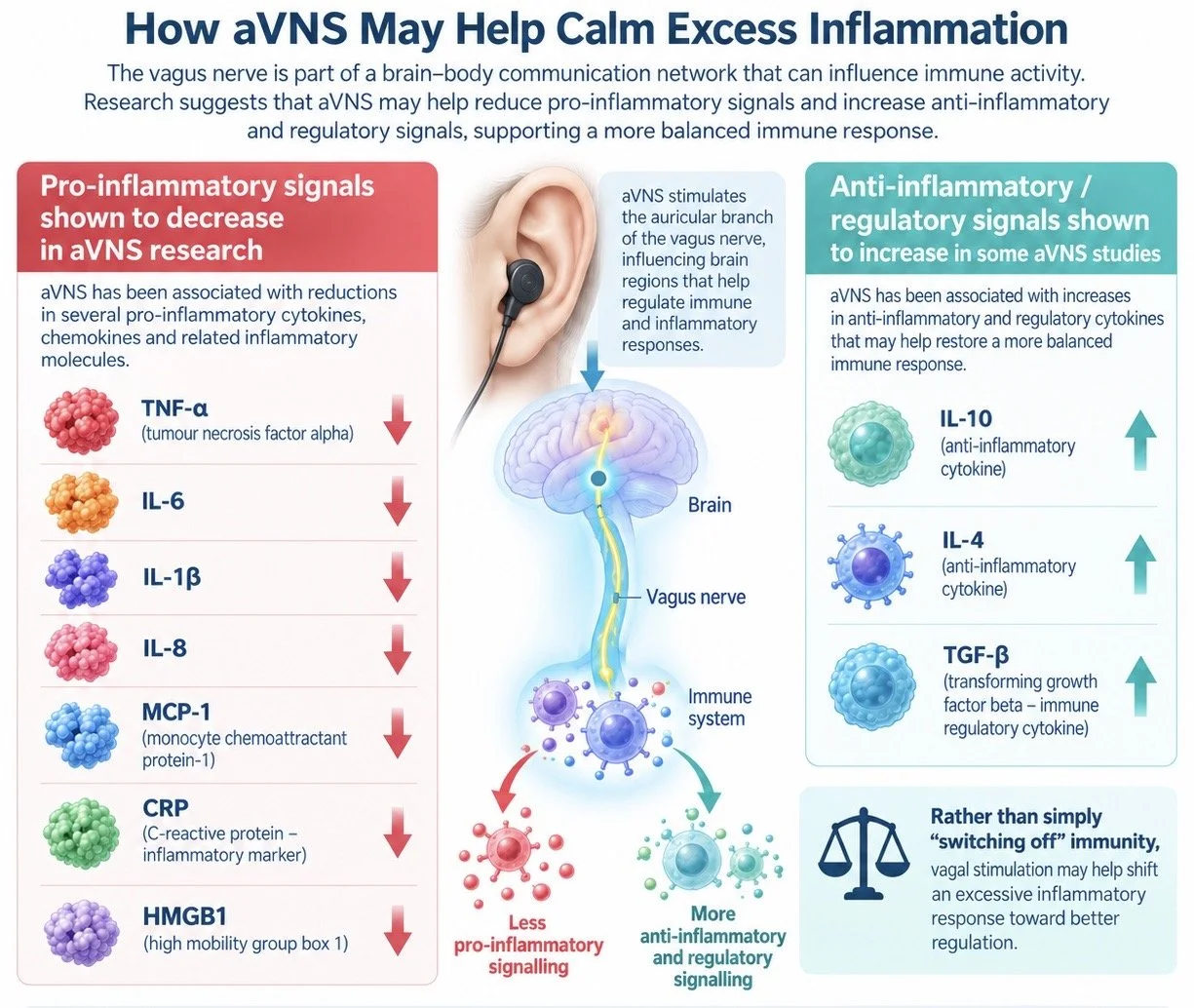
Researchers have demonstrated changes in important inflammatory signals following vagal stimulation, including CRP, TNF-α, IL-6, IL-1β and other inflammatory mediators. These objective findings are particularly valuable because they show that the effects of vagal stimulation can extend beyond people simply feeling better—measurable changes in inflammatory biology have occurred.
The aim is not to indiscriminately “boost” or suppress immunity. It is to support the body’s ability to regulate inflammation appropriately and return towards balance once an inflammatory response has served its purpose.
This is one of the important goals of Luminnova InnateSignal™.
Acute Inflammatory Conditions
Acute illness sometimes produces an inflammatory response so powerful that the body’s own response begins contributing to symptoms, tissue injury and organ dysfunction.
Clinical research suggests that aVNS may help the body regulate this excessive inflammatory response, and some of the findings have been remarkably rapid.
Acute pancreatitis
A 2026 multicentre randomized trial studied 60 people hospitalized with acute pancreatitis.
After only three days, CRP—an important blood marker of inflammation—had fallen by approximately 32 mg/L in patients receiving aVNS, while it had increased by approximately 13 mg/L in the comparison group.
Even more importantly for patients, the laboratory improvement was accompanied by faster clinical recovery.
By day three, approximately 50% of patients receiving aVNS had achieved substantial symptom improvement, compared with only 13% of those receiving standard treatment alone.
This is a good example of why the inflammatory findings matter. The goal is not simply to produce a better laboratory result—the hope is that better regulation of inflammation translates into feeling better and recovering more quickly.
Similar findings in other acute illnesses
Positive findings have now appeared in several very different clinical settings.
In acute ischemic stroke, aVNS altered the pattern of IL-6 and reduced several other inflammatory signals, including IL-1β and IL-17α.
In a 2026 randomized trial involving 120 people undergoing thyroid surgery, patients receiving aVNS had lower postoperative IL-6 and TNF-α, but they also experienced less pain and nausea, shorter hospital stays and better overall recovery.
Another 2026 randomized study involving older surgical patients found significantly lower IL-6 following aVNS. Postoperative cognitive problems occurred in approximately 10% of patients receiving aVNS compared with 33% in the comparison group.
And in critically ill patients with sepsis and acute gastrointestinal injury, aVNS was associated with better movement of the stomach and a greater ability to reach nutritional targets, alongside changes in inflammatory and intestinal-barrier markers.
The repeated combination of measurable biological changes and better clinical outcomes is particularly encouraging.
Across 27 randomized trials involving more than 1,100 participants, a systematic review also found significant overall effects of auricular stimulation on several inflammatory markers.
Taken together, the evidence increasingly supports something important: stimulating the vagus nerve can measurably influence inflammatory regulation in humans.
Acute COVID-19
COVID-19 provided a particularly clear demonstration of how an immune response intended to protect us can sometimes become part of the problem.
In severe infection, excessive release of inflammatory mediators can contribute to tissue injury and deterioration. This made regulation of the inflammatory response an obvious potential target for vagus nerve stimulation.
And there is direct human evidence.
In a randomized hospital-based study of acute COVID-19, aVNS was associated with an approximately 38% reduction in IL-6 and 24% reduction in CRP within seven days compared with comparison stimulation.
These are substantial changes in two important markers of systemic inflammation.
The significance extends beyond COVID-19 itself. Together with findings from pancreatitis, surgery, stroke and other acute illnesses, the study provides further evidence that aVNS can engage inflammatory regulatory pathways even when the body is experiencing significant acute inflammation.
Luminnova recommends treatment at an earlier stage of infection to reduce the likelihood of progression to a severe state or persistent symptoms after infection. While randomized control trials have not been published in early CoVID-19 there are promising case reports supporting this rationale.
Naturally for acute CoVID-19 and other severe acute inflammatory conditions, aVNS should be considered as an additional supportive measure along with appropriate medical care - not the primary treatment.
Explore Lumminova InnateSignal™
Learn more about the Luminnova InnateSignal™ aVNS Program, including how the program works, what to expect, treatment options and how to determine whether InnateSignal™ may be appropriate for you.
Click here to explore the InnateSignal™ aVNS Program.
REFERENCES
Acute Inflammation | COVID-19
COVID-19
Transcutaneous Auricular Vagus Nerve Stimulation Improves Inflammation but Does Not Interfere with Cardiac Modulation and Clinical Symptoms of Individuals with COVID-19: A Randomized Clinical Trial. 2022. PMID: 36295080.
Randomized human aVNS trial — including IL-6 and CRP outcomes.
Acute Pancreatitis
Feng J, Chen L, Lou L, et al. Transcutaneous Auricular Vagal Nerve Stimulation Alleviates Symptoms of Mild Acute Pancreatitis: A Multicenter Randomized Double-Blind Controlled Study. American Journal of Gastroenterology. 2026. doi:10.14309/ajg.0000000000004060. PMID: 42153655.
Multicenter randomized human trial.
Sepsis
Wu Z, Zhang X, Cai T, et al. Transcutaneous auricular vagus nerve stimulation reduces cytokine production in sepsis: An open double-blind, sham-controlled, pilot study. Brain Stimulation. 2023;16(2):507–514. doi:10.1016/j.brs.2023.02.008. PMID: 36801260.
Randomized human pilot — significant reductions in pro-inflammatory cytokines and increases in anti-inflammatory cytokines.
Wu Z, Zhang X, Li Y, et al. Transcutaneous auricular vagus nerve stimulation is associated with higher gastric antral motility in septic patients with acute gastrointestinal injury: A randomized, sham-controlled pilot trial with blinded outcome assessment. Brain Stimulation. 2026;19(4):103154. doi:10.1016/j.brs.2026.103154. PMID: 42392443.
Randomized human pilot — objective gastrointestinal motility and physiological outcomes in sepsis.